
This article is educational, not investment advice. Perpetual futures can result in rapid losses, including the loss of the full margin posted. Check the contract specifications and risk rules of the exchange you use before placing an order.
Perpetual futures position size should be decided before a trade is opened. A good futures trade begins with a number most people choose last: position size.
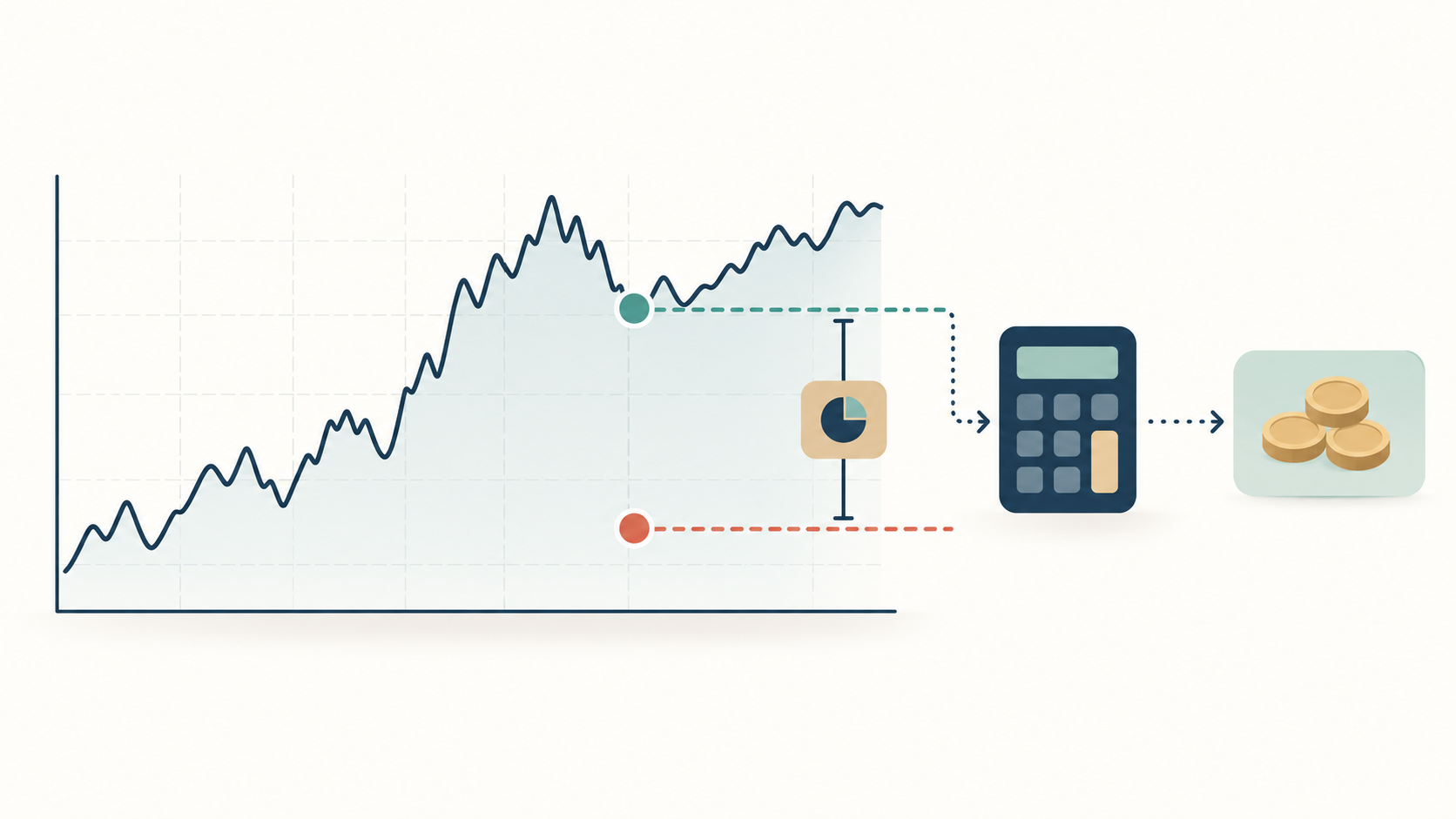
Try the numbers before placing an order: use the Position Size & Stop-Loss Calculator to estimate quantity, position notional, and margin from your account risk, entry, and stop. It runs in your browser and is an educational estimate, not exchange-specific order advice.
Table of contents
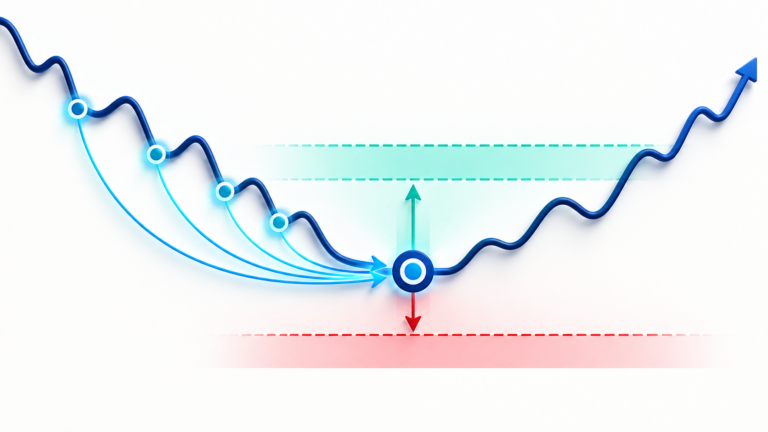
It is easy to start with a conviction, select a high leverage setting, and work backwards to a quantity. That approach makes the loss depend on emotion and on the available margin. A more disciplined approach reverses the order: decide where the trade is wrong, decide how much of the account may be lost if that happens, and let those two numbers determine the quantity.
For linear, USDT-margined perpetual contracts, the basic calculation is pleasantly simple. The details around it—fees, slippage, contract rules, and liquidation—are where care matters.
Start with a fixed dollar risk
Choose a maximum loss for one idea, expressed in dollars rather than in a percentage move or a number of contracts. For example, an account of $10,000 might have a $100 risk limit for a single trade. That is 1% of the account.
This is a risk budget, not a target. If the stop is reached, the intended outcome is a small, predefined loss—not a reason to move the stop farther away.
Perpetual Futures Position Size: The Core Formula
For a linear perpetual contract quoted in USDT, use:
Position size (in coins) = Dollar risk ÷ |Entry price − Stop price|
The vertical bars mean “absolute value”: use the distance between entry and stop whether the position is long or short.
For a long position, the stop is below the entry. For a short position, the stop is above the entry. In both cases, the price distance tells you how much one coin would lose if the stop were filled at the planned price.
A worked long example
Assume the following plan for BTCUSDT:
| Input | Value |
|---|---|
| Account value | $10,000 |
| Maximum trade risk | $100 |
| Planned entry | $100,000 |
| Stop-loss price | $98,750 |
The stop distance is $1,250 per BTC.
Position size = $100 ÷ $1,250 = 0.08 BTC
At a $100,000 entry, 0.08 BTC has a notional value of $8,000. If the position closes at $98,750 exactly, the price loss is approximately:
0.08 × $1,250 = $100
That is the important result. The quantity follows the risk plan; it is not chosen because it “feels small” or because the account can open a larger position.
Leverage changes margin, not the planned loss
Leverage is often confused with risk. In the example above, the notional position remains $8,000 whether 2×, 5×, or 10× leverage is selected. What changes is the initial margin needed to carry it.
| Leverage | Approximate initial margin for an $8,000 position |
|---|---|
| 2× | $4,000 |
| 5× | $1,600 |
| 10× | $800 |
The planned loss at the stop is still about $100 before trading costs. Higher leverage can leave less room between the entry and liquidation price, though. It does not make a trade safer simply because less margin is committed.
Build in room for costs and imperfect fills
A stop is not a guarantee of an exact exit price. Market orders can slip during fast moves, and fees are charged when a position opens and closes. Funding can also matter when a position is held through a funding event.
One practical method is to reserve part of the risk budget for those costs. If the total risk limit is $100, a trader might size the price move for $90 or $95 and leave the rest as a buffer. Using $95 in the example gives:
$95 ÷ $1,250 = 0.076 BTC
The exchange’s quantity step may require rounding down. Rounding up would exceed the risk limit.
Check liquidation before sending the order
A stop-loss and a liquidation price are not the same thing. The stop is your chosen exit; liquidation is the exchange’s forced-risk mechanism. If liquidation can occur before a stop is triggered or filled, the risk calculation has failed in practice.
Before entering, check the estimated liquidation price in the order ticket. Keep meaningful distance between it and the stop price, especially in volatile markets. Exchanges may use mark price rather than last price for liquidation and, depending on their rules, for stop triggers. Maintenance margin tiers, fees, funding, and cross versus isolated margin can all affect the result.
Short positions use the same logic
Suppose a short entry is planned at $100,000 with a stop at $101,000 and a $100 risk limit. The stop distance is $1,000, so the preliminary size is:
$100 ÷ $1,000 = 0.10 BTC
The direction changes; the sizing process does not. Define the invalidation level first, calculate the distance, then divide the risk budget by that distance.
Perpetual Futures Position Size Checklist
- Set the entry and the price that invalidates the trade.
- Choose a fixed dollar amount you can lose on the idea.
- Calculate quantity from the stop distance, then round down to the contract’s allowed step.
- Allow for entry fees, exit fees, funding, and potential slippage.
- Confirm the required margin and ensure liquidation is not uncomfortably close to the stop.
- Place or verify the protective stop according to the exchange’s trigger rules.
For more practical risk-management guides, visit Becofree. Position sizing will not make an uncertain trade certain. It does something more useful: it keeps one incorrect decision from becoming an account-level problem.
For an exchange-specific explanation of USDⓈ-M P&L mechanics, see Binance Futures documentation.
Contract mechanics vary by exchange and by contract type. Inverse or coin-margined contracts use different P&L and sizing conventions, so do not apply the linear USDT formula to them without checking the relevant contract specifications.
Further reading: Proper Position Size — CME Group.