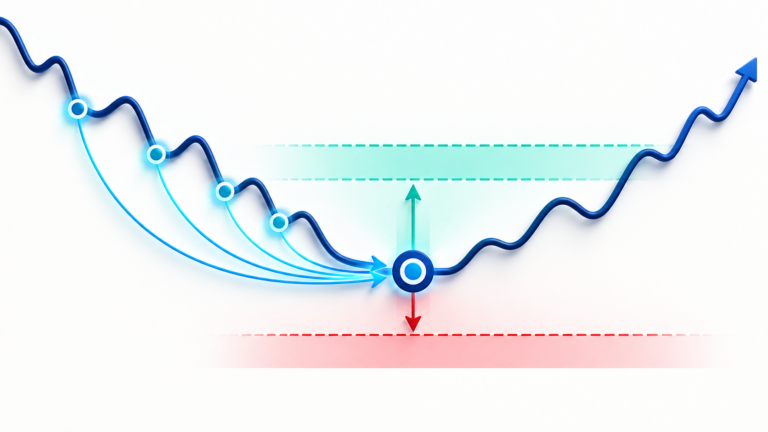

Trading fees and funding rates starts with a risk question, not a prediction. A trade can be directionally correct and still disappoint after costs. Trading fees and funding rates are part of the position, especially when entries are frequent, leverage is high, or a perpetual position stays open for several funding intervals.
Table of contents

Separate entry and exit fees
Most futures venues charge when you open and when you close. Maker and taker schedules can differ, and a limit order is not automatically a maker fill if it crosses the book. Estimate both sides before calling a trade profitable.
Understand what funding does
Funding is a periodic transfer between longs and shorts designed to keep a perpetual contract near its underlying market. A positive rate generally means longs pay shorts; a negative rate reverses that direction. The rate is not a prediction and it can change before the next settlement.
Small percentages become meaningful
A small fee looks harmless on one order, but notional exposure is what determines the charge. High turnover and high leverage can make costs large relative to the collateral committed. Compare expected gross P&L with costs in the same currency.
Include costs in break-even
Break-even is not always the entry price. A long position needs enough favorable movement to cover entry fees, exit fees, and any funding paid. The same applies to shorts in the opposite price direction.
Do not hold only to avoid realizing a loss
Funding can turn a short-term trade into an expensive wait. If the original setup is invalidated, extending the holding period simply because the fee has already been paid can add a new decision error.
Use the Fee & Funding Calculator Before You Enter
Turn the idea into numbers before placing an order. The Fee & Funding Calculator helps you compare the relevant inputs and check whether the planned risk still fits your account rules.
A Practical Checklist
- Define the maximum dollar amount you are willing to lose before entry.
- Check fees, funding, margin mode, and liquidation risk where relevant.
- Use the information in this guide as context rather than a standalone signal.
- Write the invalidation level and exit rule before the trade is live.
- Review the result after the trade so the next decision is evidence-based.
For a related risk-management guide, read Why Your Liquidation Price Changes After Opening a Trade. The goal is not to eliminate uncertainty; it is to make sure uncertainty cannot turn one idea into an uncontrolled loss.
A Hypothetical Fee and Funding Calculation
Assume a linear perpetual position opens and closes at a notional value of ,000, with an illustrative fee of 0.05% on each side. Entry and exit fees would total ( each) if the notional stayed unchanged. If a hypothetical funding rate of 0.01% were paid on ,000 at each of three settlements, the simplified funding estimate would be another . With a gross gain, the example would end about negative before spread, slippage, and any changes in notional. These rates are examples, not a quote for any exchange or account.
Actual funding is assessed at exchange-defined settlement times and may use the position value at each settlement; fees depend on venue, product, tier, and execution. This calculator uses simplified inputs, so compare its estimate with the transaction history and current venue rules.
Further reading: Funding Rate and Settlement — Binance Support.
Educational content only; this article is not investment advice. Futures and perpetual products carry a substantial risk of loss. Contract mechanics, fees, and available products vary by exchange and jurisdiction.