
Atr Stop Loss is a risk-management topic before it is a performance topic. ATR can help describe recent price movement, but an ATR-based stop loss does not set position size for you. The stop distance and the dollar amount you are prepared to lose must be considered together.
Table of contents
Atr Stop Loss: A Practical Framework
Atr Stop Loss works best when it is applied before entry and reviewed after the trade. It should help control the amount at risk, not create confidence that a market outcome is certain.
Know what ATR measures
Average True Range is a volatility measure derived from the true range over a chosen lookback period. It describes recent movement in price units; it does not indicate direction and it does not predict the next move.
Use ATR as context, not a fixed answer
Some traders place stops a multiple of ATR away to avoid setting a stop inside ordinary noise. The appropriate multiple depends on the instrument, timeframe, strategy, and market condition. A volatility measure cannot replace the structural reason a trade is invalidated.
Convert volatility distance into size
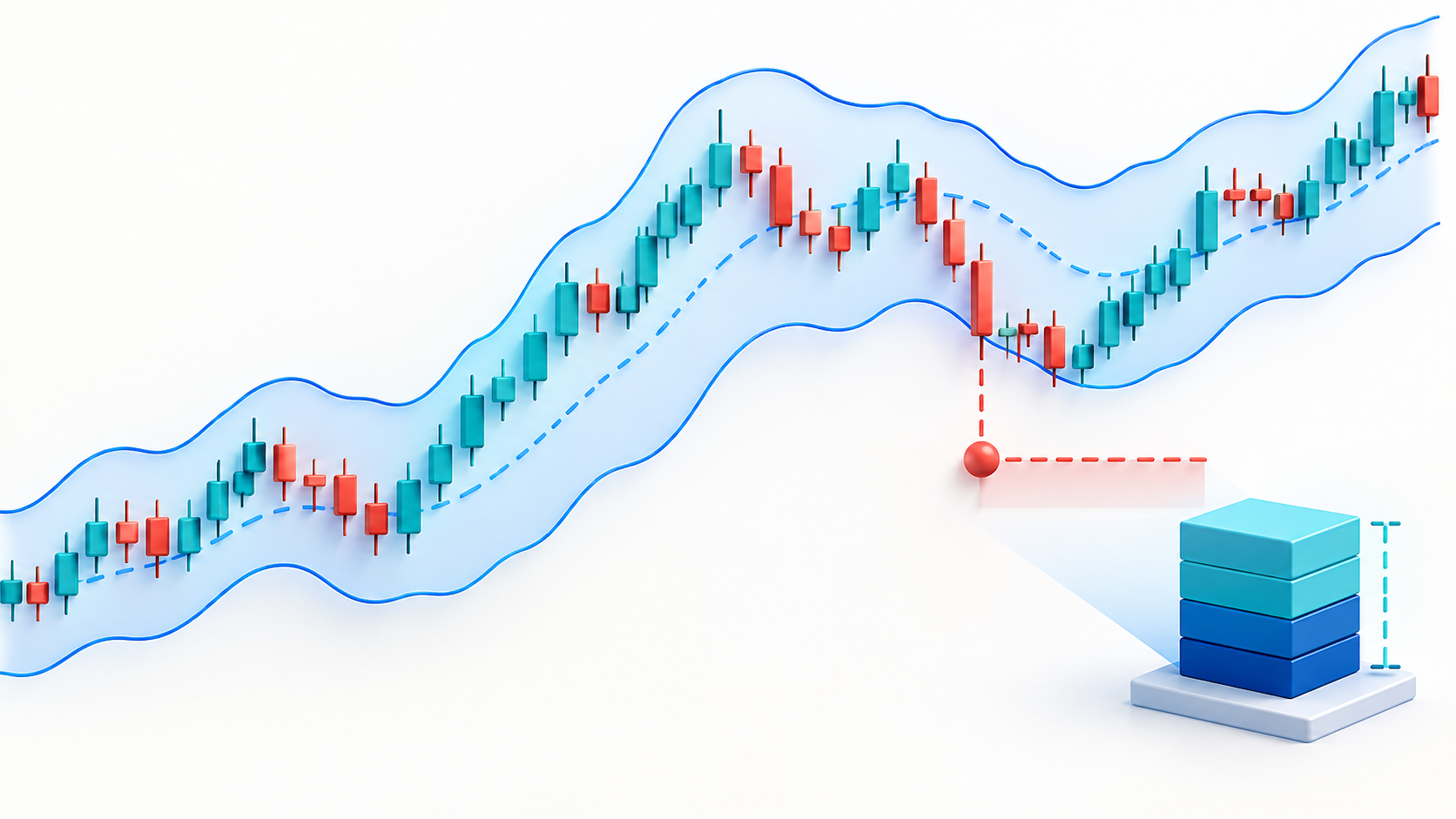
A wider ATR-based stop means a larger entry-to-stop distance. If the dollar risk limit stays fixed, quantity must decrease. Keeping the same size while widening the stop increases the planned dollar loss.
Recheck when volatility changes
ATR can expand rapidly after a volatile move and contract during quiet periods. Using a stale reading can produce a stop that is either too close to current conditions or too wide for the planned risk. Define when the measure will be refreshed.
Do not use ATR to justify leverage
A volatility-based stop still needs enough margin room and a liquidation estimate beyond the planned exit. High leverage can put liquidation too close even when an ATR multiple looks reasonable on a chart.
ATR Stop Loss: Keep Volatility and Size Together
An ATR stop loss uses recent volatility as context for the distance between entry and exit. It can help avoid placing a stop inside typical movement, but it does not prove that a chosen level is structurally valid or that the trade should be taken.
When an ATR stop loss is wider, position size must be smaller if the dollar risk limit is unchanged. This is the essential connection many templates miss: volatility changes the distance, while position size controls the amount lost at that distance.
Refresh the ATR stop loss assumption when market conditions materially change, and leave room for spread, fees, and imperfect fills. In leveraged futures, confirm liquidation remains well beyond the planned exit rather than treating the ATR calculation as a substitute for margin planning.
Common Mistakes to Avoid
An ATR-based distance is only a volatility allowance. If a hypothetical 14-period ATR is $1.20, a 1.5-ATR distance is $1.80; a $45 price-risk cap would permit 25 linear units before costs. The trader still needs to decide whether a stop $1.80 away sits beyond a meaningful invalidation level. If the chart structure needs a wider stop, reduce quantity rather than letting the ATR multiple dictate the thesis.
Keep ATR stop loss connected to the same process. Use it before entry, use it when conditions change, and use the post-trade review to identify whether the plan or its execution needs improvement. This approach is deliberately less exciting than reacting to every move, but it makes risk measurable and repeatable.
Use the Calculators Before You Enter
Translate the plan into inputs before sending an order. The Position Size & Stop-Loss Calculator can help test position size, remaining break-even, costs, or liquidation distance using your own assumptions. These tools provide estimates, not trading signals.
A Practical Checklist
- Write the entry, invalidation level, maximum dollar loss, and quantity.
- Check whether fees, funding, and likely slippage fit inside the loss budget.
- Confirm the liquidation estimate is not the intended exit.
- Use ATR stop loss to improve a risk plan, not as a standalone prediction.
- Review the actual result and execution after the position is closed.
Further reading: Average True Range — TradingView. Check the contract and fee rules published by the venue you use.
Further reading: Average True Range — TradingView.
Educational content only; this article is not investment advice. Futures and perpetual products carry a substantial risk of loss. Rules, fees, and available products vary by exchange and jurisdiction.