
A futures plan is a short record of what would justify an entry, what would prove the idea wrong, and how much the position can lose under stated assumptions. Writing these decisions before an order is live makes later review more useful.
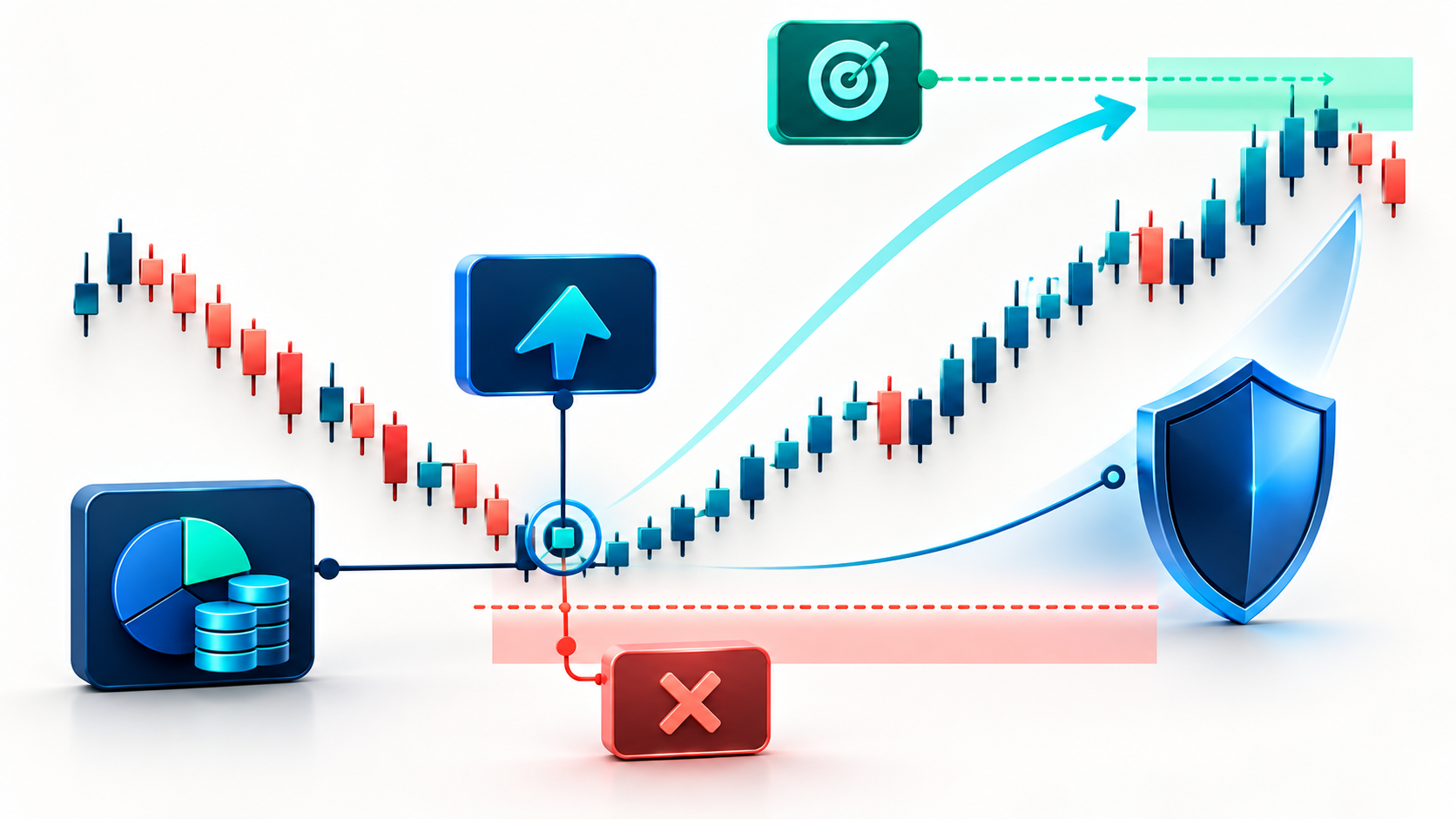
The Five Decisions a Plan Should Record
- Market and contract: identify the exact instrument and whether its value is linear, inverse, or multiplier-based.
- Entry condition: describe an observable condition, not a prediction such as “price should rise.”
- Invalidation: name the price or condition that means the thesis no longer applies.
- Risk and size: set a dollar loss limit and calculate quantity from the actual entry-to-stop distance and contract value.
- Management: record the intended exit, partial close, or stop-adjustment rule and what would change it.
Example: A Plan With Numbers
Assume a hypothetical account of $5,000 and a chosen $50 maximum price risk. If a linear contract entry is $100 and the planned invalidation is $98, the price distance is $2 per unit, so 25 units represent $50 of price risk before fees and slippage. A possible target at $104 describes a gross 2:1 reward-to-price-risk relationship, but it does not imply that the target is likely to be reached. If the actual fill is $101, the same stop creates $3 of risk per unit, and the quantity must be recalculated.
Separate the Plan From the Forecast
A written plan cannot remove uncertainty or guarantee that a stop fills at its trigger. Market orders, limit orders, funding, maintenance margin, and venue-specific contract rules affect execution and exposure. Keep the stop where the thesis is invalidated; reduce quantity or decline the trade if the resulting risk is too large rather than moving the stop for convenience.
After the trade, compare the plan with actual fills, fees, and decisions. The position-size calculator can check the arithmetic, while CME Group’s trade plan worksheet offers a general checklist format.
A Final Preflight Check
Before submitting an order, confirm whether the contract is linear or inverse, what one unit represents, which margin mode is selected, and what fee tier applies. Recalculate if the actual fill differs from the planned entry. If the position is held through a funding settlement, note the direction and rate assumption. These details make the plan auditable and prevent a simple price-distance estimate from being mistaken for a complete account-risk model.
Educational information only; not investment advice. Futures and perpetual products can result in rapid losses. Exchange rules, fees, contract units, and available products vary. Verify details with your venue.