
Linear and inverse perpetual contracts can both track the price of an asset, but they do not express profit and loss in the same unit. A position-size or P&L formula that is valid for a stablecoin-settled linear contract should not be copied into an inverse contract without adjusting for its contract multiplier and settlement currency.
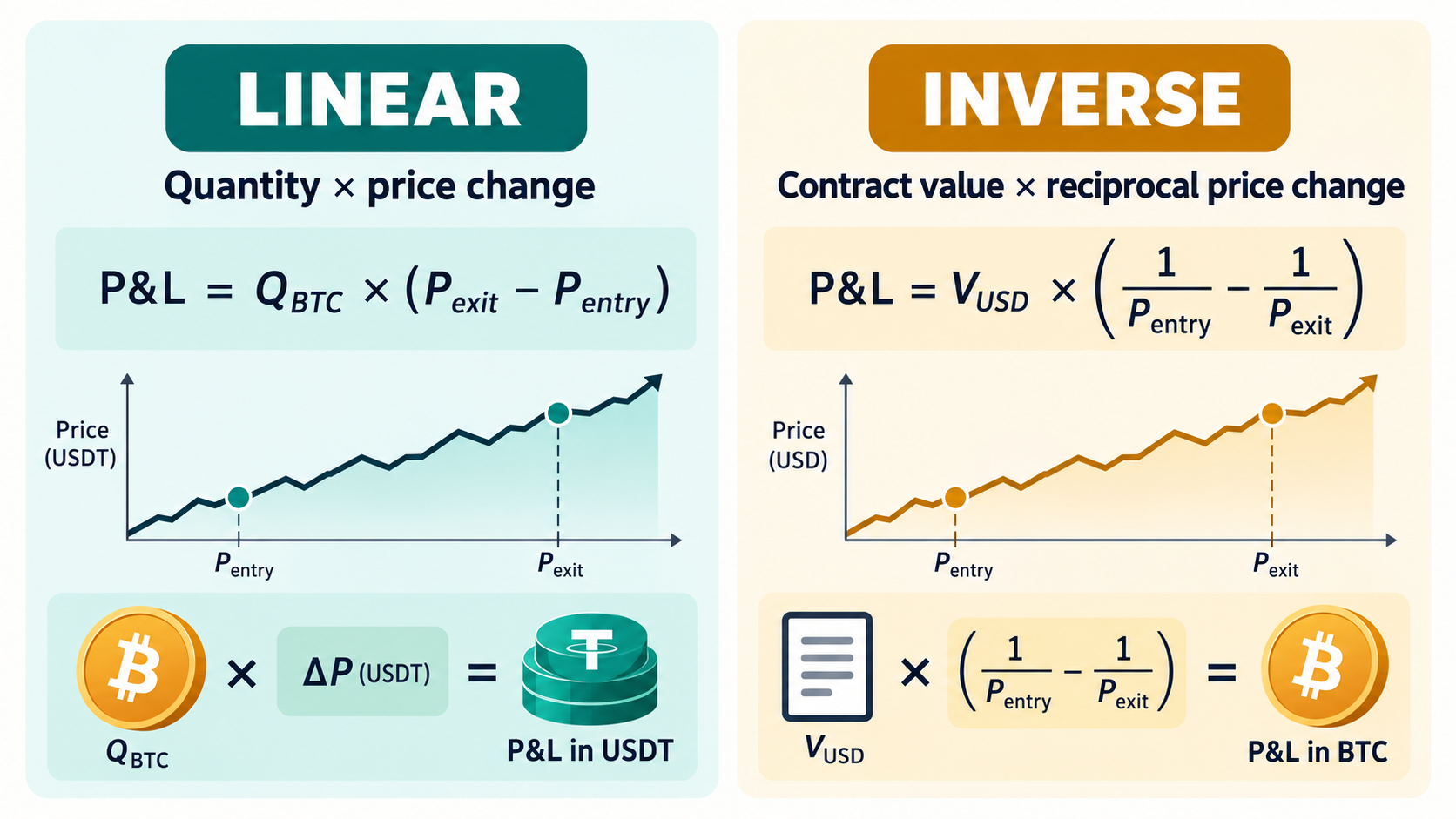
Table of contents
How a linear contract measures P&L
In a simplified linear contract quoted and settled in a stablecoin, a long position’s gross P&L is quantity × (exit price − entry price); a short reverses the sign. If a hypothetical long holds 0.2 BTC from $50,000 to $55,000, the gross result is 0.2 × $5,000 = $1,000 USDT, before fees, funding, and execution differences. The position quantity is expressed in the underlying asset while P&L is in the quote or settlement currency.
This linear relationship is the basis of the simple examples in many position-size tools. It is still essential to check the product specification: exchanges can define quantity steps, contract multipliers, settlement assets, and margin tiers differently.
How an inverse contract differs
An inverse contract can have a fixed quote-currency contract value while collateral and P&L are settled in the underlying coin. For a common inverse formula, long P&L in coin is contract count × contract value × (1 ÷ entry price − 1 ÷ exit price). The result is not a fixed-dollar amount of coin: its value in dollars changes with the coin’s market price.
That reciprocal-price formula means equal dollar moves at different price levels do not produce equal coin-denominated P&L. It also means that “quantity” may mean a number of contracts rather than units of the underlying coin. Read the multiplier and settlement asset before interpreting any result.
A same-notional worked example
Consider two simplified long positions that each start with approximately $10,000 of notional exposure at a $50,000 BTC price. A linear position of 0.2 BTC that closes at $55,000 has gross P&L of $1,000 USDT. For an inverse illustration, suppose the contract specification is $100 of contract value per contract and the position is 100 contracts. The inverse P&L is 100 × $100 × (1/50,000 − 1/55,000), or about 0.01818 BTC. At a $55,000 exit price, that is worth about $1,000 before costs.
The approximate dollar results match in this example, but the settlement units do not: one result is USDT and the other is BTC. If the inverse profit remains in BTC, its dollar value changes with the BTC price, and any loss is deducted from BTC collateral. A display that shows only a dollar estimate can hide that conversion risk.
Costs follow the same unit logic. A taker fee on an inverse contract is normally charged in the settlement coin, so a 0.05% fee on 100 contracts of $100 face value at $50,000 is about $5, or roughly 0.0001 BTC, not a fixed dollar deduction. Funding and liquidation penalties are also applied in coin on many inverse venues. Before comparing two positions, convert both the P&L and the costs into the same unit at the same price.
Why the stop-distance sizing formula also changes
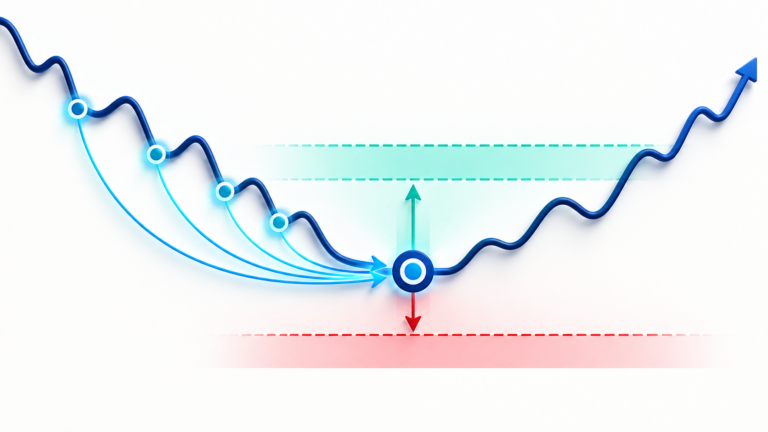
For a linear contract, a first-pass size estimate divides the dollar risk budget by the entry-to-stop distance, then adjusts for fees, slippage, and contract units. An inverse contract’s loss per contract is not simply the price distance multiplied by an underlying-coin quantity. With a $100 multiplier, 100 inverse contracts long from $50,000 to $49,000 lose about 100 × $100 × (1/50,000 − 1/49,000), or 0.00408 BTC. At $49,000, that is approximately $200 of value. A sizing method must calculate risk in the settlement asset and convert it at a stated price; the exact exchange formula and rounding rules belong to the product.
This distinction matters even when the entry notional looks similar. A risk budget stated in dollars, collateral held in BTC, and P&L settled in BTC are three different quantities. The conversion price used to display the result can change the dollar equivalent without changing the BTC amount credited or debited.
Rounding behaves differently in each convention. A linear order can be expressed in fractional coins, so a $100 budget with a 2% stop from $50,000 works out to about 0.10 BTC, and a venue with a 0.001 BTC step can match that closely. An inverse order rounds to whole contracts, and one contract of $100 face value at that stop distance risks only about $2, so the same budget needs roughly 50 contracts. The rounding error is proportionate to the size of one contract, not to the fee.
What a calculator must know
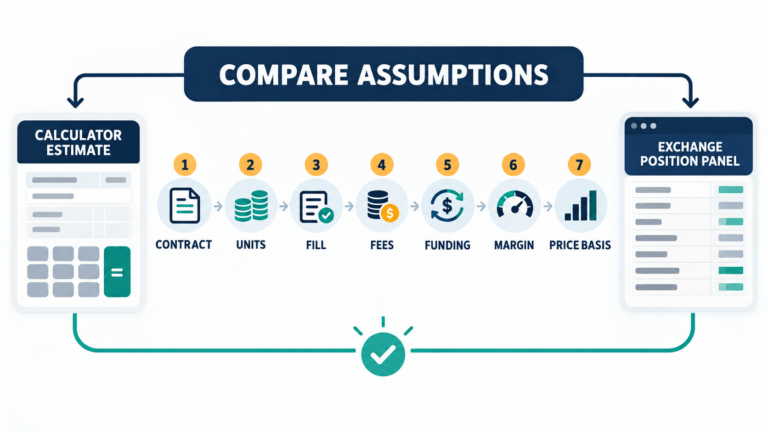
The Becofree Position Size, Liquidation Price, DCA / Average Entry, and Fee & Funding calculators use simplified linear-style inputs. They do not accept an inverse contract multiplier or calculate coin-settled inverse P&L. Their quantity and liquidation outputs are not inverse-contract order instructions; confirm the venue’s contract specification and compare with the exchange’s own order panel and calculator.
For a deeper explanation of sizing by stop distance, read How to Calculate Position Size for Perpetual Futures. Binance’s own references explain its USDⓈ-M and COIN-M calculator formulas and contract P&L calculations; those rules are venue-specific, not universal market rules. We have not independently verified these external pages and do not control their content.
The boundary matters most when the quantity field means something else. Do not enter “100 contracts” into a linear quantity field as if it meant 100 BTC: the linear output would be wrong by orders of magnitude because it multiplies underlying units by the price change. The same caution applies to stop sizing, since inverse loss per contract depends on reciprocal prices and face value.
A useful audit record saves the product name, contract type, multiplier, quantity unit, entry and exit prices, settlement currency, and fee and funding treatment. If any field is unknown, the calculation is not ready to compare.
Pre-trade contract checklist
- Is the contract linear or inverse, and which asset settles the P&L?
- Does the order quantity mean coins, contracts, or another unit?
- What contract multiplier and price source does the venue use?
- Are fees, funding, collateral conversion, and maintenance tiers included in the estimate?
- Does the calculator model the same contract type as the position you intend to trade?
Educational information only; this article is not investment advice. Leveraged derivatives can produce rapid losses. Contract specifications and exchange rules vary, so verify the current terms for the exact product, and note that external links may change.