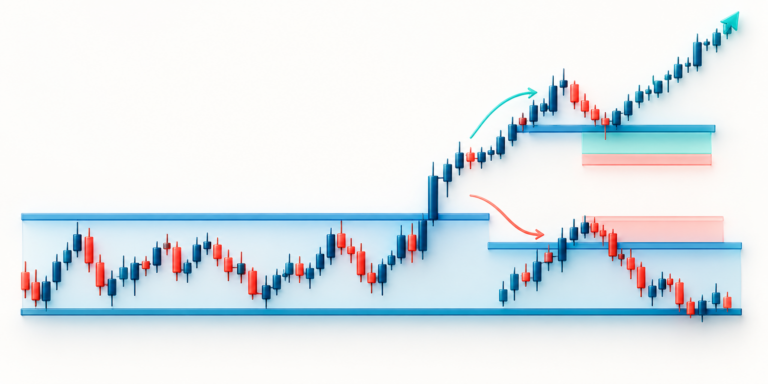

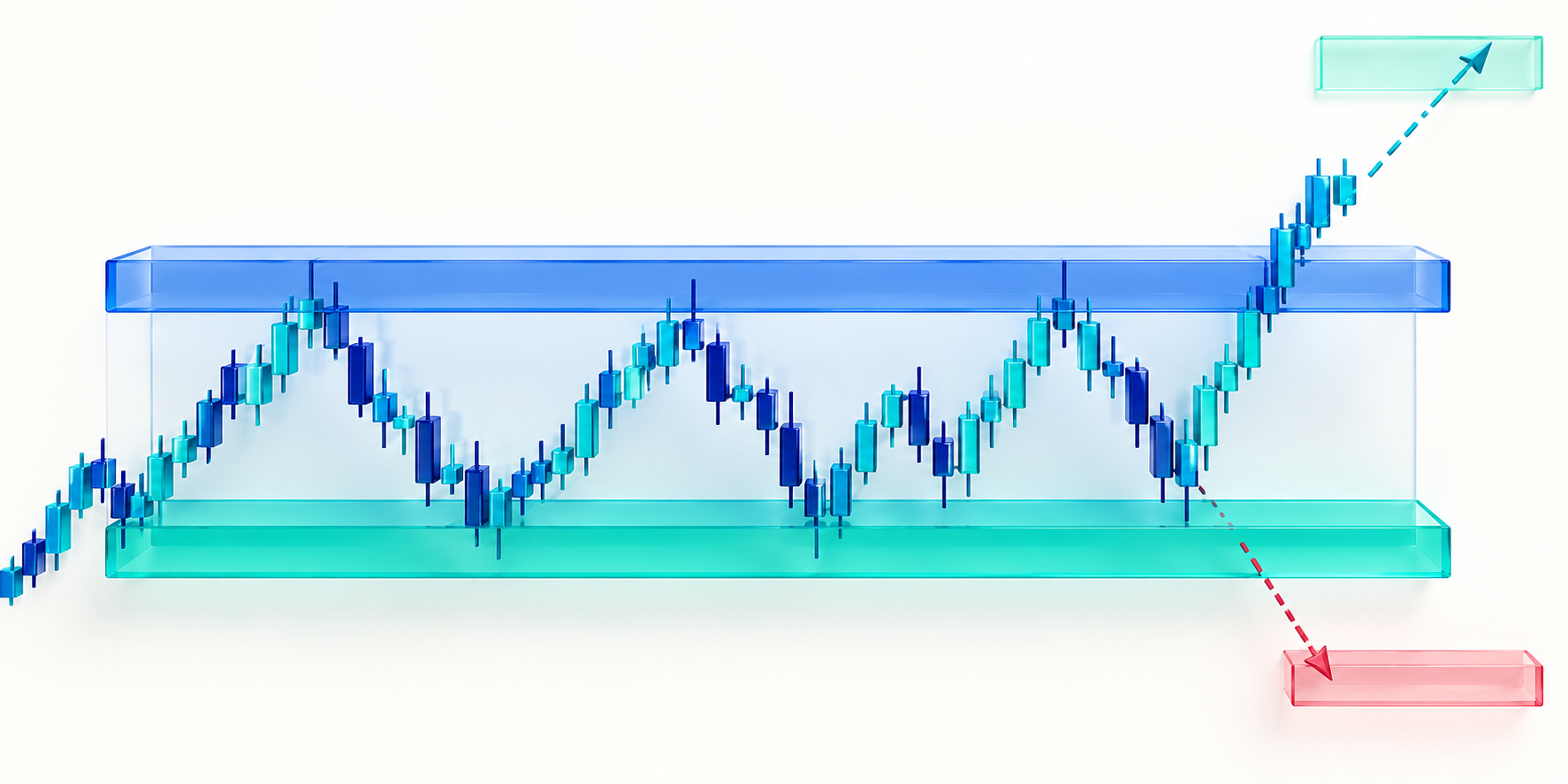
Range trading starts with a testable observation: price has repeatedly moved between broad areas without establishing a sustained move beyond them. Those boundaries are zones inferred from past prices, not fixed barriers that must hold again.
Define the Range and Its Failure Condition
Mark the repeated reaction areas and the interval used to identify them. A range becomes less useful when price begins closing beyond a boundary or when volatility changes enough to make the old width irrelevant. Decide in advance whether your rule requires an intrabar break, a closing price, or a failed retest. There is no single definition that fits every market.
Example: Location Changes the Payoff
Imagine a hypothetical range between $95 and $105. A long idea near $96 with invalidation at $94 risks $2 per unit. A $40 price-risk budget allows 20 linear units before costs. If a possible exit is near $104, the gross distance is $8 per unit, but that arithmetic does not estimate the chance of reaching it. If entry slips to $100 while the $94 invalidation remains, risk rises to $6 per unit and the same budget supports about 6.7 units; only $4 remains to the illustrative $104 exit.
A Boundary Can Break
Do not assume that a touch of support must bounce or a touch of resistance must reverse. News, liquidations, and changes in participation can push price beyond a previously observed zone. If the range premise fails, follow the planned invalidation rather than widening the stop to wait for the old pattern to return.
Entry Location Changes the Remaining Room
An entry near the middle of a range has less distance to the opposite boundary than an entry near the edge, all else equal. This is a geometric observation, not a probability estimate. Compare the planned target distance with the stop distance after fees and likely slippage. If the available room is small, the setup may no longer match the plan even though the range itself is still visible.
Questions Before Considering a Range Setup
- Are both boundaries supported by repeated observations on the chosen interval?
- Is the planned entry near an area where the remaining reward can justify the risk?
- Where exactly is the range thesis invalidated?
- Have quantity and costs been recalculated from the actual fill?
Use the position-size calculator after the stop is set. CME Group’s trade plan worksheet is a useful general prompt for documenting risk, not a range signal.
Educational information only; not investment advice. Futures and perpetual products can result in rapid losses. Exchange rules, fees, contract units, and available products vary. Verify details with your venue.