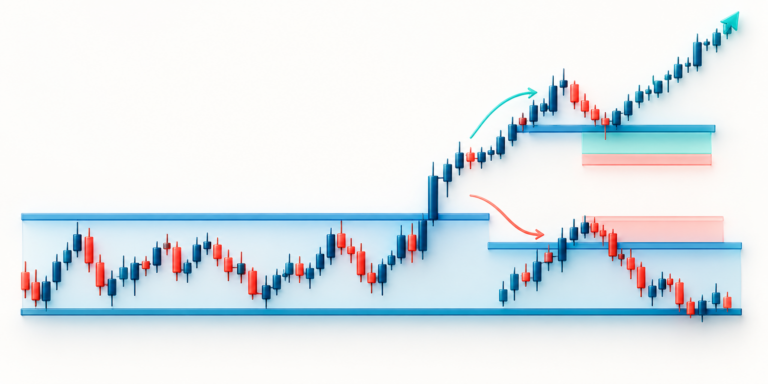

A trailing stop changes an exit level as price moves favorably according to a preset rule. It can help formalize an exit process, but it does not guarantee that the position will close at the trailing level or capture a market high.

Three Ways a Trail Can Be Defined
A fixed-distance trail follows price by a constant amount. A percentage trail uses a proportional distance. A structure-based rule moves only after a specified swing or other price condition is confirmed. Each behaves differently across instruments and volatility regimes; an ATR-based distance also depends on the selected interval and lookback.
Example: A Tight Trail Can Exit Before Continuation
Suppose a hypothetical long enters at $100 and reaches $108. A 5% trail from the high would place a reference level near $102.60. A pullback to that level may close the position before price rises again. That is a possible consequence of the chosen rule, not necessarily a system failure. A wider trail may remain open longer but can give back more open profit.
Test the Rule on the Instrument and Interval
Define when trailing begins, whether it updates intrabar or only after a candle closes, and what happens after a partial exit. Evaluate the same rule across both quiet and volatile periods and include fees and slippage. Avoid choosing a trail only because it would have fit one past chart.
Distance Is a Trade-Off, Not a Universal Setting
A trail based on a small percentage may react quickly but can be reached by ordinary fluctuations. A wider distance can remain open through more noise but may surrender more open profit before exit. An ATR-based trail changes when recent range changes, so it still needs a fixed lookback, interval, and update rule. Compare methods on the same sample and include periods that challenge the rule.
Understand the Trigger and Order Behavior
Exchange implementations differ, and a triggered stop may become a market or limit order. In a fast move, its fill may be worse than the reference level; a stop-limit may not fill. Review your venue’s stop-order guide and use the position-size calculator to estimate initial quantity from the stop you actually plan to use.
Educational information only; not investment advice. Futures and perpetual products can result in rapid losses. Exchange rules, fees, contract units, and available products vary. Verify details with your venue.