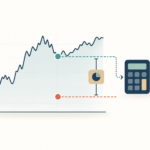

Trend pullback trading describes looking for a retracement within a broader directional structure. The difficult part is not naming the pattern; it is defining what would show that the continuation idea has failed before taking risk.

Describe the Structure Before Calling It a Pullback
Choose a chart interval and mark the relevant swing highs and lows. A sequence of higher highs and higher lows can describe rising structure; it does not guarantee that the next low will hold. Decide which prior swing or other price condition would invalidate the continuation hypothesis. Treat support as an area to evaluate, not a guaranteed floor.
Example: A Late Entry Changes the Risk
Suppose price rises from $50 to $60, retraces, and later trades at $57. A trader’s hypothetical invalidation is $54, three dollars below entry. With a $45 price-risk budget, the simple linear quantity is 15 units before costs. If the entry is chased at $59 while the same $54 invalidation remains, risk per unit becomes $5 and the budget supports 9 units. Keeping 15 units would raise planned price risk to $75. The chart pattern is unchanged, but the trade economics are not.
What Can Make the Idea Fail
A retracement can deepen, a prior swing can break, or a new event can change volatility and execution. A stop that is too close to fit a desired quantity may be inconsistent with the setup; a stop farther away may require a smaller quantity. Do not treat a trend label as a reason to ignore a stop, fees, or liquidation distance.
Shallow and Deep Retracements Are Different Cases
A shallow pullback may leave little room between the entry and nearby invalidation, while a deeper one can approach the swing that supported the original trend description. Neither is automatically better. Compare the actual stop distance, the next relevant price area, and the potential execution cost. If the stop needed to invalidate the thesis is too far away for the chosen risk limit, reducing quantity is more coherent than forcing a tighter stop.
From Invalidation to Quantity
Write the entry condition and invalidation first, then estimate quantity from the allowed dollar loss. The position-size calculator helps with that arithmetic, but it does not determine whether a pullback is valid. CME Group’s position-sizing lesson also emphasizes the relationship between stop placement and acceptable risk.
Educational information only; not investment advice. Futures and perpetual products can result in rapid losses. Exchange rules, fees, contract units, and available products vary. Verify details with your venue.