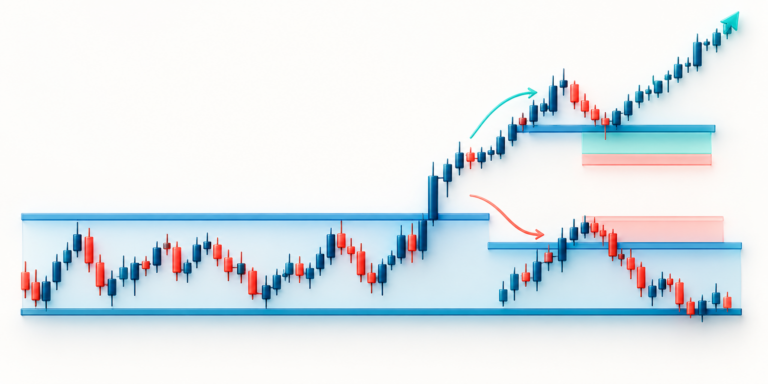

A useful futures process includes conditions for standing aside. A setup may be recognizable but still be unsuitable when the entry has moved, the invalidation is vague, costs are unusually high, or the account is already exposed to a similar risk.

Four Reasons to Pause Before Entry
First, pause if you cannot state the setup and its invalidation in plain language. Second, pause if the planned entry is gone and retaining the old stop would exceed the risk budget. Third, check spread, depth, and event conditions: a normal-looking chart can be difficult to execute during thin liquidity or a fast announcement. Fourth, notice account context. Several positions tied to the same market can create more concentrated exposure than their individual risk figures suggest.
These are review prompts, not universal market rules. A scheduled event does not automatically make every trade wrong, and a wide spread does not prove a market is untradeable. The decision should follow the trader’s own written limits and the instrument’s contract specifications.
Example: The Entry Has Moved
Suppose a hypothetical long was planned near $100 with invalidation at $98 and a $50 price-risk cap. The simple quantity is 25 linear units before costs. If price has already moved to $103 while the original $98 invalidation remains necessary, risk per unit becomes $5 and the cap allows only 10 units. Moving the stop to $101 just to preserve 25 units changes the original thesis. The choices are to reassess a genuinely new setup or pass; the missed move is not itself a loss.
A Short Stand-Aside Checklist
- Can I identify the entry condition and the price that invalidates it?
- Does the actual entry still fit the planned risk and execution assumptions?
- Are spread, fees, slippage, funding, and overlapping positions considered?
- Am I reacting to a previous loss, urgency, or fear of missing out?
If an answer is unclear, record what information is missing and wait for that condition to resolve. A no-trade decision is a process outcome, not proof that the market will move in one direction.
Record Why You Passed
Write down the missing condition, such as a late fill, a stop that no longer fits the risk cap, or an event that makes execution assumptions uncertain. Later, compare the decision with the rule you set before the outcome was known. Do not grade a pass only by whether price subsequently moved in the expected direction; that would reward hindsight rather than a repeatable process.
Translate a Valid Setup Into a Risk Limit
Only after a setup and invalidation are defined should quantity be estimated. The position-size calculator estimates quantity from account risk and stop distance; it cannot decide whether a setup is high quality. See CME Group’s position and risk management overview for a general planning framework.
Educational information only; not investment advice. Futures and perpetual products can result in rapid losses. Exchange rules, fees, contract units, and available products vary. Verify details with your venue.